

miRNA inhibition oligos
AUMantagomir
Self-delivering antisense oligonucleotides for microRNA inhibition
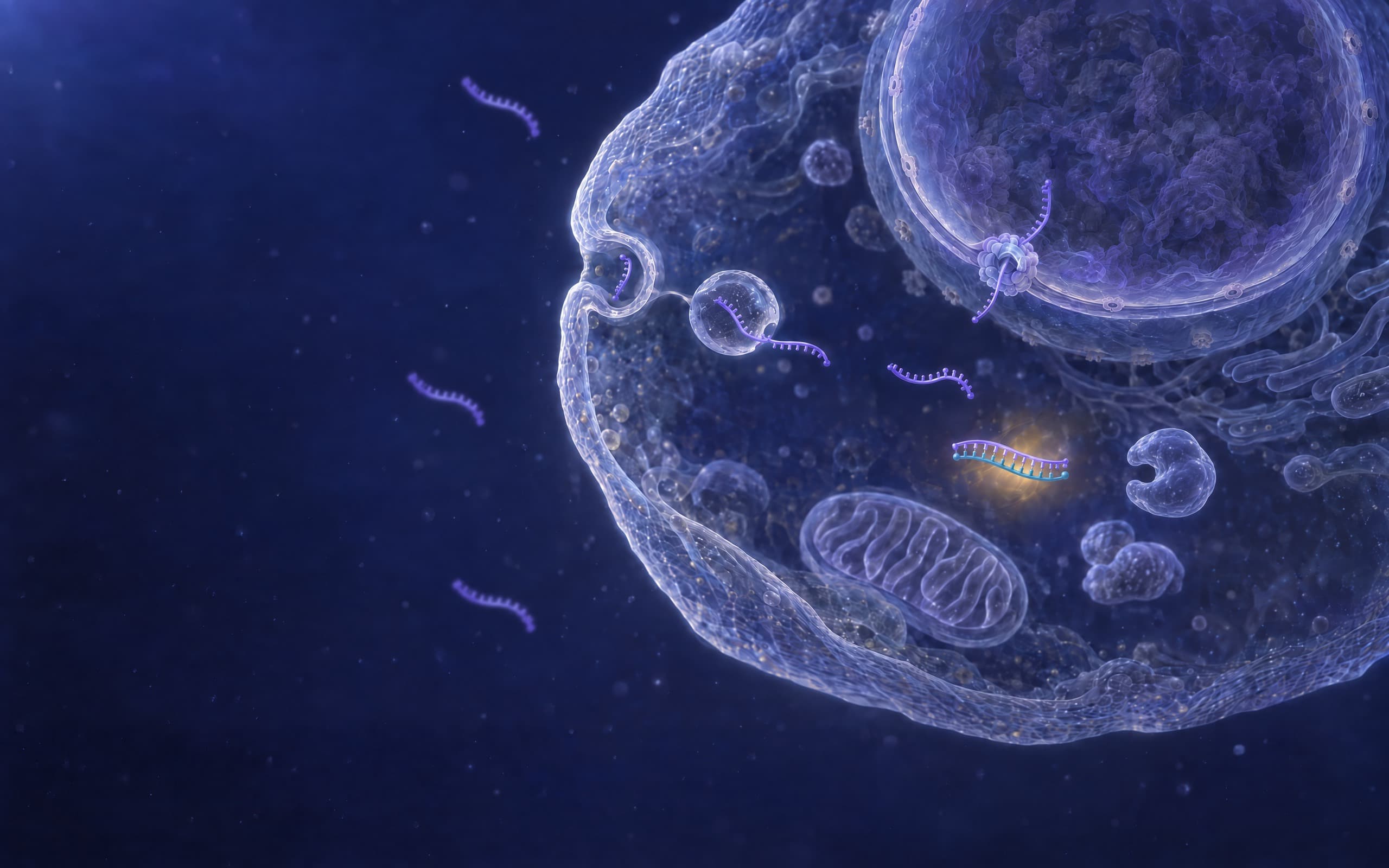
AUMantagomir
Many microRNA studies are done in primary neurons, cardiomyocytes and tissue explants, which are difficult to transfect with conventional methods. Transfection reagents, electroporation, or viral vectors can introduce toxicity, alter the cellular response, or require additional optimization. Built on the same AUMsilence platform as our other products, AUMantagomir
- MicroRNA inhibition and target de-repression
AUMantagomir
sdASOs inhibit the target microRNA, and the genes it represses are de-repressed. - No transfection required
AUMantagomir
sdASOs are added directly to cell culture, with no transfection reagent, electroporation, or viral vector. - Minimal toxicity
AUMantagomir
sdASO shares the low toxicity profile of our other ASOs. - High binding affinity to microRNA
The chemical modifications in AUMantagomir
sdASO confer high binding affinity to RNA targets.
Sizes and purification
- RPC
- 10 · 25 · 50 · 100 nmol
- HPLC
- 25 · 50 · 100 nmol
- Labeled, HPLC
- 25 nmol · FAM, Cyanine 3, Cyanine 5, Cyanine 7
Prices and lead time are shown on the order page. Custom sizes by quote.
At a glance
- Class
- Self-delivering antisense (sdASO)
- Targets
- miRNA inhibition
- Delivery
- Add to culture medium or inject in vivo.
- Fluorescent label
- FAM, Cyanine 3, Cyanine 5 or Cyanine 7
In the lab
The protocol in four steps
The steps below are the AUMantagomir
Step 1
Cell preparation
Plate cells in their optimum growth medium at a density appropriate for the cell type. A confluency of 50-70% at the time of treatment is typical.
Step 2
AUMantagomir
sdASO stock preparation Prepare AUMantagomir
sdASO stock solution by reconstituting lyophilized ASOs at the desired concentration. If you already have a stock solution prepared, skip to Step 3. Step 3
AUMantagomir
sdASO delivery to cells Add AUMantagomir
sdASO to the cells at the desired final concentration. The recommended working range is 5-20 μM, with a starting concentration of 10 μM. The optimal concentration varies with the target gene, the RNA class (messenger RNA, microRNA or long non-coding RNA) and the cell type, and should be determined by titration for each system. Step 4
Incubation and analysis
Incubate cells with AUMantagomir
sdASO and analyze miRNA inhibition at appropriate time points.
In vitro, the four steps
Step 1
Prepare cells
Seed the cells in a 24-well plate; the oligonucleotide waits in solution.
Step 2
Add to the medium
Add the self-delivering oligonucleotide straight to the medium: no transfection reagent, no carrier.
Step 3
Incubate
Incubate at 37 degrees C in 5% carbon dioxide, humidified, for the exposure time.
Step 4
Quantify knockdown
Measure the knockdown: RT-qPCR, immunoblot, flow cytometry.
Schematic of the three readouts, not data.
Sources
- The pictures are the object pictures of AUM BioTech's workflow slide, rendered views of the objects on a white ground; none is a photograph of an experiment and none records a measurement.
- Tile 04 is a schematic of the three readouts, not data: the two conditions are drawn with a modest difference to show what each readout is, and no magnitude is asserted.
Why
Features of AUMantagomir
MicroRNA inhibition and target de-repression
AUMantagomir
sdASOs inhibit the target microRNA, and the genes it represses are de-repressed. In rat hippocampal slices, an AUMantagomir sdASO against miR-134-5p lowered the microRNA, and in slices exposed to amyloid beta it restored CREB-1 and BDNF expression. No transfection required
AUMantagomir
sdASOs are added directly to cell culture, with no transfection reagent, electroporation, or viral vector. Primary tissue explants and organotypic slices are treated the same way. Minimal toxicity
AUMantagomir
sdASO shares the low toxicity profile of our other ASOs. Traditional miRNA inhibitors often require high concentrations or complex formulations that can cause cell stress. By avoiding transfection reagents and using a chemistry optimized for biocompatibility, AUMantagomir sdASO ensures that any observed effects are due to miRNA inhibition, not off-target toxicity. High binding affinity to microRNA
The chemical modifications in AUMantagomir
sdASO confer high binding affinity to RNA targets. This means even a low-abundance microRNA can be captured by an AUMantagomir sdASO. How much of the microRNA is held away from its natural targets depends on the AUMantagomir sdASO's concentration and on its affinity relative to those targets.
Mechanism
Mechanism of action
MicroRNA binding: AUMantagomir
MicroRNA inhibition vs. degradation: Depending on the design, an AUMantagomir
Self-delivery: Like our other products, AUMantagomir
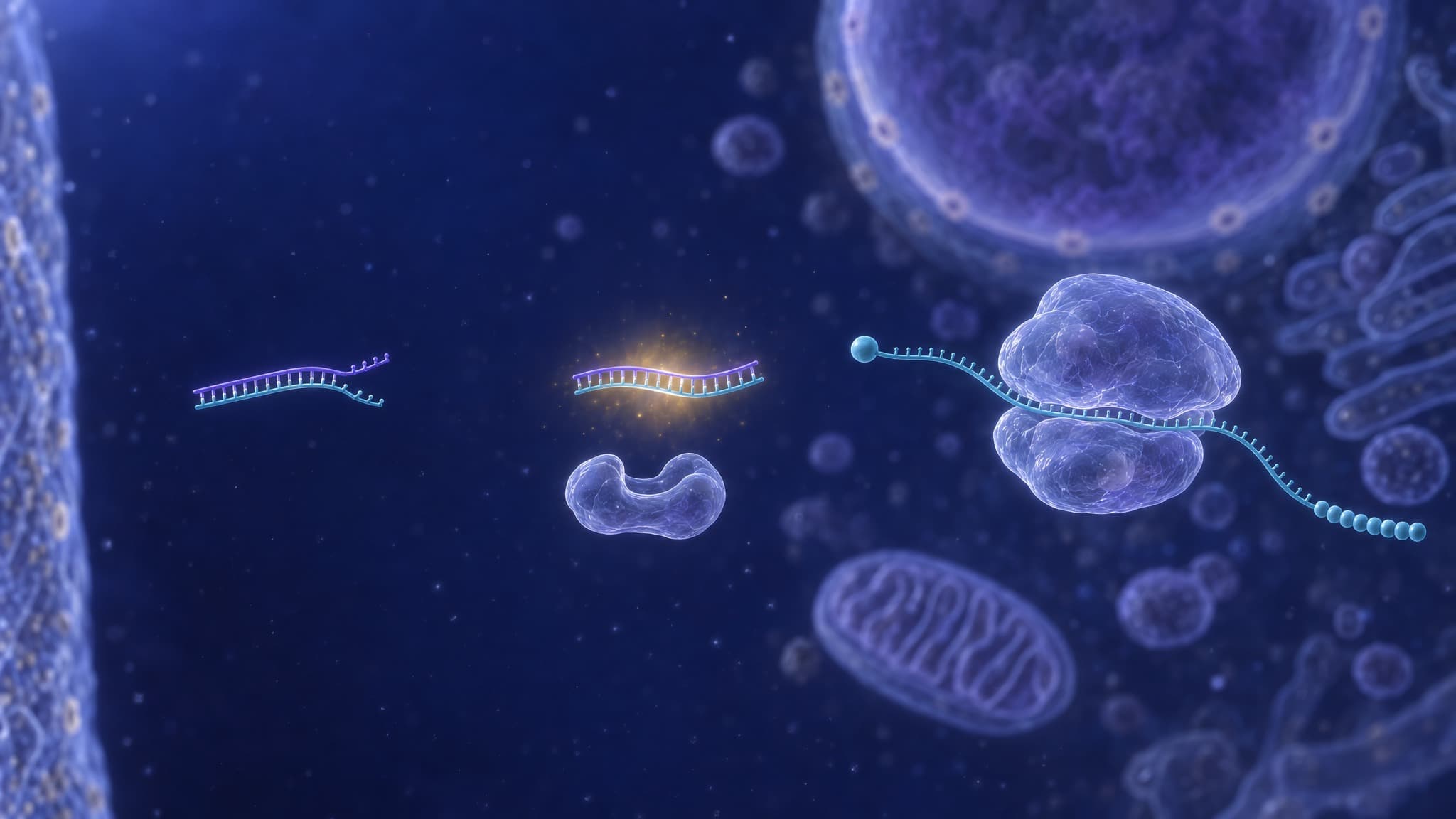
- Stage 1
AUMantagomir
sdASOs enter cells without needing a transfection reagent. - Stage 2
AUMantagomir
sdASOs are typically fully complementary (or heavily complementary) to the microRNA sequence of interest. A single microRNA (~22 nucleotides) can be entirely bound by the AUMantagomir sdASO. - Stage 3
Upon binding, the ASO-microRNA duplex can prevent the microRNA from assembling with the RNA-induced silencing complex (RISC) or from attaching to its target mRNAs. This neutralizes the microRNA's regulatory effect.
Applications
Applications and use cases
Functional studies of microRNAs
If you hypothesize a certain microRNA regulates a pathway (for example, miR-134-5p in synaptic plasticity or let-7a-5p in angiogenesis), inhibit the microRNA with AUMantagomir
sdASO and read the outcome. Target discovery
Use AUMantagomir
sdASO to identify what genes a microRNA controls. After treatment with an AUMantagomir sdASO and transcriptomic analysis, the transcripts that rise are likely direct or indirect targets of the microRNA. Disease models
Many diseases involve dysregulated microRNAs (fibrosis, cancer, neurodegeneration). AUMantagomir
sdASOs are used in cellular and animal models of disease to model sustained microRNA inhibition. Difficult-to-transfect cells
AUMantagomir
sdASOs can enter primary macrophages and neurons in culture without a transfection reagent, electroporation, or a viral vector.
Every compatible cell type, 3D model, organoid and in vivo route, with the in vitro workflow.
See where it worksExperimental considerations
The working concentration is higher than that of a transfected oligonucleotide. The recommended working range for AUMantagomir
Because an AUMantagomir
In the literature
AUMantagomir
McDonald et al. · Nature Communications · 2024
Space radiation damage rescued by inhibition of key spaceflight associated miRNAs
AUMantagomir oligonucleotides against three spaceflight associated microRNAs, added at 0.5 μM to a three dimensional human microvessel culture, preserved vessel shape after 0.5 Gy of simulated galactic cosmic radiation. They returned DNA repair, inflammatory and mitochondrial gene programmes towards their unirradiated levels.
Baby et al. · Aging Cell · 2020
MicroRNA‐134‐5p inhibition rescues long‐term plasticity and synaptic tagging/capture in an Aβ(1–42)‐induced model of Alzheimer’s disease
An AUMantagomir sdASO against miR-134-5p, bath applied at 1 μM to acute hippocampal slices with no transfection reagent, gave 80% knockdown. It restored both late long-term potentiation and synaptic tagging and capture in an amyloid beta model in young rats. The knockdown, the potentiation rescue and the messenger RNA rise held in aged mouse slices as well.
Hayslip et al. · GeroScience · 2026
Space radiation and microgravity as models of accelerated aging: modulation of hepatic miRNA-TGF-β networks associated with senescence and fibrosis
In mice exposed to simulated deep-space radiation and microgravity, AUMantagomir oligonucleotides against miR-16-5p, miR-125b-5p and let-7a-5p lowered all three target microRNAs in the liver and shifted TGF-beta pathway, senescence and inflammation transcripts back toward baseline. Both fibrosis transcripts measured, Col1a1 and Col4a1, rose further with treatment under galactic cosmic radiation.
Wuu et al. · iScience · 2020
LET-Dependent Low Dose and Synergistic Inhibition of Human Angiogenesis by Charged Particles: Validation of miRNAs that Drive Inhibition
AUMantagomir sdASO against miR-16-5p, miR-125b-5p and let-7a-5p, added to human three dimensional micro-vessel cultures with no transfection reagent, restored the blood vessel formation that simulated deep space radiation had blocked.
At the bench
Protocol, controls and what arrives
Add to culture medium or inject in vivo. The protocol, the controls and the How much to order page are written for this product.
- Lead time
- 10-14 business days
- Shipping
- Products are shipped lyophilized, with priority shipping within the United States and international priority shipping elsewhere.
- Quality control
- Every oligo is strictly controlled for quality and is manufactured in an ISO 9001:2015 certified facility.
Order AUMantagomir
Name the mature microRNA, with its arm, and the species. The AUMsilence platform designs oligonucleotide sequences against it, and sequence design is included in the order price. A scientist is available before ordering to discuss the target and the cell type.
For research use only. Not for use in diagnostic or therapeutic procedures.